
Two studies shed light on the link between the state of the microbiota and longevity
Aging well does not just depend on our genes. Research is now exploring the intestinal microbiota as a potential factor in the aging process. Two recent studies shed new light on this link, which is still under investigation.


A microbiota that changes throughout life
The intestinal microbiota refers to all the microorganisms living in our digestive tract.
It evolves from birth and changes over the years under the influence of many factors, including diet, lifestyle and environment.
In adolescents and young adults, it often reaches a high level of microbial diversity. With age, its composition can become less stable, with some species declining while others increase (1).
To study this complex ecosystem and draw out relevant observations, researchers are analysing in particular:
- bacterial diversity
- the stability of microbiota composition over time
- the production of metabolites, such as short-chain fatty acids
- interactions with the immune system
In some studies, a less diverse microbiota has been associated with chronic low-grade inflammation, sometimes called 'inflammaging' (2).
This low-grade inflammation is itself associated with a progressive decline in certain functions (3) that we see as we age, such as:
- muscle function
- energy vitality
- certain cognitive abilities
Diet, physical activity and, more broadly, lifestyle influence the composition and functioning of the intestinal microbiota.
To the extent that we can influence these parameters on a daily basis, we could potentially be acting indirectly on this ecosystem.
Two studies look at the links between microbiota and aging
Results revealing links between microbiota and maintenance of vitality
A narrative review summarising several studies linking microbiota and aging
This review (4) summarises several experimental studies suggesting that alterations in the microbiota could be associated with chronic low-grade inflammation, often referred to as 'inflammaging'.
It also discusses the role of the intestinal barrier: an increase in permeability could promote the passage of certain bacterial compounds into the bloodstream, potentially contributing to systemic inflammation.
The intestine-muscle axis is also discussed, with studies suggesting that certain metabolites produced by the microbiota could be associated with variations in muscle mass and function.
The gut-brain axis has been a particular focus of study in recent years, and is also being explored, particularly via interactions between the microbiota, the immune system and neurotransmitters.
Finally, the production of short-chain fatty acids, particularly butyrate, is presented as a key mechanism: by helping to maintain the integrity of the intestinal barrier, these metabolites could contribute to immune modulation.
In conclusion, the review mentions probiotics, prebiotics and postbiotics as potential avenues for nutritional intervention, while reiterating the need for further clinical trials.
An observational study in adults aged over 60
In this study (5), the researchers compared older adults with a group of very elderly individuals (aged 90 and over).
In the oldest group, they described a microbiota enriched in bacterial genera such as Akkermansia and Bifidobacterium: these could therefore be more typical of the microbiota of people who reach a very advanced age.
The study also reports associations between certain bacteria and physical function parameters, in particular grip strength.
Correlations are also explored with factors such as anxiety and certain dietary habits, such as milk consumption, which could influence the composition of the microbiota.
The authors point out, however, that these are primarily observational associations, and that a correlation does not demonstrate a causal link.
Ultimately, the review and the study support the idea that some microbial profiles could be associated with better vitality in the very elderly, without it being demonstrated that they are the direct cause.
Mechanisms that could explain the potential impact of the microbiota on aging
Several plausible biological mechanisms have been proposed to explain the associations observed between microbiota and aging.
Short-chain fatty acids, such as butyrate, could be associated with inflammatory balance by serving as a source of energy for colon cells and helping to maintain the integrity of the intestinal barrier.
In fact, a more functional intestinal barrier is likely to limit the passage of certain pro-inflammatory compounds into the bloodstream, which could help modulate the chronic low-grade inflammation observed with age.
Links have also been suggested between microbiota and muscle function. In some experimental models, bacterial metabolites could influence the mechanisms involved in protein synthesis and the maintenance of muscle mass.
Finally, the study of the gut-brain axis highlights complex interactions between the microbiota, the nervous system and the immune system, which could be associated with certain neuro-psychological aspects observed during aging.
However, these data are mainly based on experimental models or observational studies, and do not demonstrate that a particular microbiota increases lifespan.
Above all, they support the idea that the microbiota constitutes a serious field of research into the health of the aging population, influenced in particular by diet and lifestyle.
How can we support our microbiota as part of a 'pro-longevity' approach?
The main pillars of a diverse and stable microbiota are based, above all, on a healthy lifestyle:
- eating a varied diet rich in fibre from legumes, fruit, vegetables and wholegrain cereals
- limiting ultra-processed and high-sugar foods
- engaging in regular physical activity
- maintaining good-quality sleep
- managing stress on a daily basis
- reducing or eliminating alcohol and tobacco consumption
Dietary fibre plays a central role, as it serves as a substrate for intestinal bacteria that produce short-chain fatty acids, which have been studied for their interaction with metabolic and inflammatory balance.
Within this overall framework, certain food supplements can form part of a coherent nutritional approach, without taking the place of an adapted lifestyle.
Probiotic-based formulas are studied for their interaction with the intestinal ecosystem and their potential role in balancing it, in certain contexts.
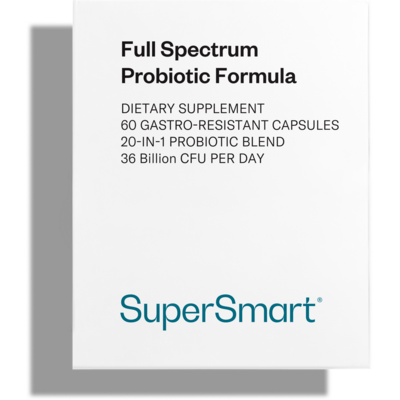
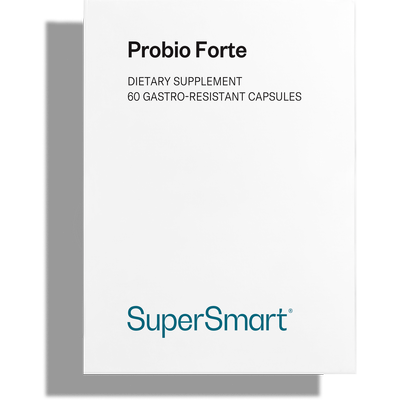
 Discover Full Spectrum Probiotic and Probio Forte food supplements, broad-spectrum multi-layer formulas for maximum microbial diversity.
You can also turn to food supplements formulated to support aging.
Research is focusing in particular on NAD+, a central cofactor in cellular energy metabolism, which is being studied for its role in specific biological pathways associated with aging.
Some supplements provide precursors that help the body to synthesise NAD+.
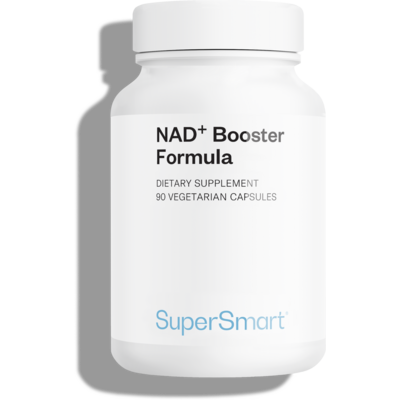
Discover the NAD+ Booster Formula food supplement, which provides precursors involved in the body's synthesis of NAD+.
More broadly, research into the biology of aging describes several mechanisms involved over the years, often grouped together under the term ‘hallmarks of aging’:
- genomic instability (DNA damage that accumulates with age)
- telomere attrition (shortening of the caps that protect chromosomes, leading to cell aging)
- epigenetic alterations (changes in the regulation of gene expression contributing to aging)
- deficient macroautophagy (impaired elimination of damaged cellular components)
- loss of proteostasis (protein misfolding and aggregation leading to cell dysfunction)
- deregulation of nutrient sensitivity (age-related disturbances in metabolic pathways)
- mitochondrial dysfunction (leading to reduced energy production and increased oxidative stress)
- cellular senescence (accumulation of 'zombie cells' releasing inflammatory signals)
- chronic inflammation (which accelerates biological wear and tear)
- depletion of stem cells (which impairs tissue regeneration capacity)
- altered cellular communication (often due to chronic inflammation)
- dysbiosis of the intestinal microbiota (imbalance)
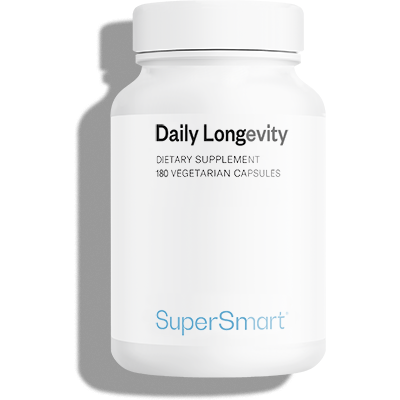
Discover the Daily Longevity food supplement, made from 13 ingredients studied for their influence on these different parameters within the body.
SUPERSMART ADVICE
References
- Badal VD, Vaccariello ED, Murray ER, Yu KE, Knight R, Jeste DV, Nguyen TT. The Gut Microbiome, Aging, and Longevity: A Systematic Review. Nutrients. 2020 Dec 7;12(12):3759. doi: 10.3390/nu12123759. PMID: 33297486; PMCID: PMC7762384.
- Ragonnaud E, Biragyn A. Gut microbiota as the key controllers of "healthy" aging of elderly people. Immun Aging. 2021 Jan 5;18(1):2. doi: 10.1186/s12979-020-00213-w. PMID: 33397404; PMCID: PMC7784378.
- Yin H, Qiu Y, Gan C, Zhou Y, Chen T and Liang M (2025) The association between a dietary index for the gut microbiota and frailty in older adults: emphasising the mediating role of inflammatory indicators. Front. Nutr. 12:1562278. doi: 10.3389/fnut.2025.1562278
- Tseng CH, Wu CY. From dysbiosis to longevity: a narrative review into the gut microbiome's impact on aging. J Biomed Sci. 2025 Oct 11;32(1):93. doi: 10.1186/s12929-025-01179-x. PMID: 41076537; PMCID: PMC12515389.
- Deng L, Xu J, Xue Q, Wei Y, Wang J. Healthy Aging and Gut Microbiota: A Study on Longevity in Adults. Microorganisms. 2025 Jul 14;13(7):1657. doi: 10.3390/microorganisms13071657. PMID: 40732166; PMCID: PMC12298205.
Keywords





15 Hours
The best supplement for…
The best supplement for hyperpigmentation or melasma. I have struggled with melasma and hyperpigmentation for 10 years. I have tried everything, including lasers. Nothing really worked except this!
NS
2 Days
Great source for high quality…
Great source for high quality supplements
Vikki L
5 Days
Recommended: "Eye Pressure"
(Eye Pressure pills) Highly recommended for glaucoma patients
LM
6 Days
Great follow-up
Great follow-up
Michael Henderson
10 Days
My hair isn't gray.
My hair isn't gray.
TANQUARY Damon
10 Days
The ease of ordering is not the only …
The ease of ordering is not the only reason why I trust Super Smart Supplements. This company researches everything they sell. Educating Me with a wealth knowledge to make Better Supplement choices. The paractin Andrographis is awesome! I noticed less Knee, shoulder or joint pain. Which proves to me, you're never too old to repair what a lifetime of intense usage has done to your body. I recommend SUPER SMART to anyone who is looking to improve their overall health & maintain an active ,pain free life as You age.
Mchael Montalbano
13 Days
Quick shipping and very good quality
Quick shipping and very good quality. I’ve bought from them for the last six months
Monig
16 Days
love the quality of the supplements!
love the quality of the supplements!
Tatiana
18 Days
Came quickly
Came quickly
Courtney Everson
18 Days
Feels great on my skin
I have only used the SuperSmart NAD face cream for a couple of weeks. So I can’t say it transformed my skin yet. However, it absorbs nicely. Is not oily or caused any acne. It feels wonderful in my routine which means I will consistently use every day! I’ve already researched the ingredients so I’m confident it will help clear the zombie cells and keep my skin looking fresh. I’m pleasantly surprised and will repurchase!
Moto
21 Days
Excellent quality
Excellent quality, I can usually tell the difference when I get other cheaper brands that are not as good. Supersmart is my first choice
MMA TUBE
24 Days
Like the product
Like the product. The bottle design is too bland.
JENKINS Rose
30 Days
Super easy and great communication
Super easy and great communication
Greg Maurer
34 Days
Cured my blood sugar issues with correct diet and almost no sugar.
Ordering was very easy and it was here within a day or two. But the best thing of all is that it fixed my blood sugar problems. I was sweating throughout the night. I had almost completely stopped sugar , which definitely helped, but I was still having sweats and this product here solved that problem. It took me years to figure it this out. I hope this helps somebody.
Rickey Matlock
38 Days
I was impressed by the patience of the representative who helped me!
I was having a very hard time trying to set up my account with them and they were very helpful and patient to get it done for me! And I was impressed by all the information they provided about the product I was purchasing!
Rebecca M.